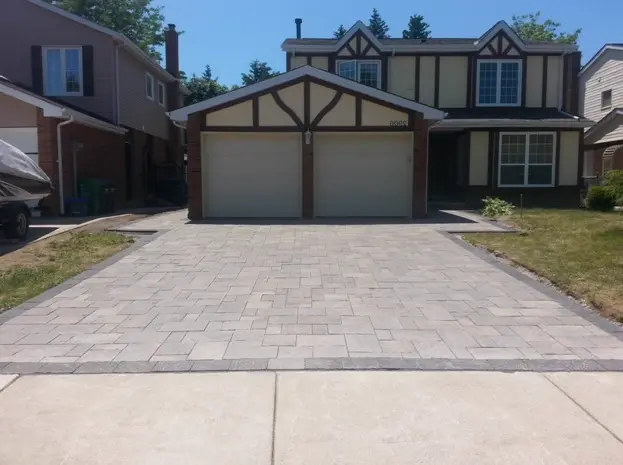
Best Interlock Patterns for Driveways: Why Herringbone Wins (And When It Doesn’t)
Discover why herringbone is the gold standard interlock pattern for Ottawa driveways, when alternatives like basketweave and running bond make sense, and how pattern choice affects durability and cost.
Choosing the right interlock pattern for your driveway isn’t just about aesthetics—it’s a critical structural decision that affects durability, stability, and long-term performance. While herringbone has earned its reputation as the gold standard for driveways, understanding why it excels (and when alternatives make more sense) can save you thousands in future repairs.
At Interlock Experts, we’ve installed hundreds of interlock driveways across the region, and the pattern debate comes up on nearly every consultation. Let’s break down the science behind interlock patterns and help you make the best choice for your property.
Why Pattern Matters: The Physics of Interlocking Pavers
Unlike poured concrete or asphalt, interlocking pavers derive their strength from how individual units lock together and distribute weight. The pattern you choose determines:
- Load distribution – How vehicle weight spreads across multiple pavers
- Resistance to shifting – How well the surface resists lateral movement from turning wheels
- Edge stability – Whether pavers at borders stay locked in place
- Freeze-thaw performance – How the pattern handles Ottawa’s brutal winter expansion and contraction cycles
In Ottawa’s climate, where we experience dramatic temperature swings from -30°C winters to +30°C summers, pattern selection becomes even more critical. The wrong pattern can lead to premature shifting, settling, and costly repairs within just a few years.
The Herringbone Pattern: Why It Dominates Driveways
Walk through any high-end Ottawa neighborhood—Kanata, Barrhaven, or Riverside South—and you’ll notice herringbone patterns dominating driveways. There’s a reason professional installers recommend it for vehicular applications.
45-Degree Herringbone: The Engineering Champion
The 45-degree herringbone pattern arranges rectangular pavers at a diagonal angle, creating a zig-zag effect that runs at 45 degrees to the driveway’s edge. This configuration is universally recognized as the strongest interlock pattern for driveways.
Structural advantages:
- Maximum interlock – Each paver locks with four neighbors, creating exceptional lateral stability
- Multi-directional strength – Forces are distributed equally in all directions, crucial for turning vehicles
- Minimal creep – Resists the gradual shifting that occurs when vehicles brake, accelerate, or turn
- Reduced edge failures – The diagonal orientation means no weak points along borders
According to the Interlocking Concrete Pavement Institute (ICPI), 45-degree herringbone patterns can handle vehicle loads 20-30% more effectively than running bond patterns. For driveways that accommodate trucks, RVs, or heavy SUVs, this isn’t just academic—it’s the difference between a driveway that lasts 25+ years versus one that needs repairs in under a decade.
90-Degree Herringbone: A Balanced Alternative
The 90-degree herringbone runs parallel to the driveway edge, creating a cleaner, more traditional look while maintaining most of herringbone’s structural benefits.
When to choose 90-degree herringbone:
- You prefer a more formal, linear aesthetic
- Your driveway has a straight, rectangular shape that complements parallel lines
- You want excellent strength without the diagonal “busy” appearance
- Material waste needs to be minimized (fewer edge cuts required)
While not quite as strong as 45-degree herringbone, 90-degree still vastly outperforms simpler patterns for vehicle traffic. The key difference: it’s slightly more vulnerable to shifting along the direction of the pattern.
When Herringbone Isn’t the Answer
Despite its technical superiority, herringbone isn’t always the optimal choice. Here’s when other patterns deserve consideration.
Basketweave: The Patio and Walkway Champion
Basketweave creates a woven appearance by laying pairs of pavers perpendicular to each other. It’s visually striking and works beautifully for interlock patios and interlock walkways.
Why basketweave fails on driveways:
The pattern creates natural weak points where perpendicular pairs meet. Under vehicle loads, these intersections become failure zones where pavers shift and settle unevenly. We’ve seen basketweave driveways develop noticeable depressions within 3-5 years of installation.
Ideal applications:
- Backyard patios with light foot traffic only
- Garden walkways
- Pool surrounds
- Decorative borders around stronger driveway patterns
Running Bond (Stretcher Bond): Simple But Limited
Running bond is the simplest pattern—pavers laid in straight rows with staggered joints, like a brick wall. It’s fast to install and uses materials efficiently.
The problem with running bond on driveways:
The pattern only provides interlock in one direction. When vehicles turn, brake, or accelerate, forces perpendicular to the joint lines can cause rows to shift as a unit. This creates the “rippling” effect you’ll see on poorly designed driveways after 5-10 years.
When running bond works:
- Driveways with minimal turning (straight in, straight out)
- Light vehicle traffic only (single car, infrequent use)
- Budget-constrained projects where aesthetics matter more than maximum longevity
- Borders and soldier courses around herringbone fields
Many professional installers use running bond as an accent border with a herringbone field—getting visual interest while maintaining structural integrity where it counts.
Random Patterns: Beauty With Caveats
Random or “Ashlar” patterns use multiple paver sizes arranged without repeating sequences. When done well, they create gorgeous, natural-looking surfaces that mimic European cobblestone streets.
The engineering trade-off:
Random patterns sacrifice some structural performance for aesthetics. The varying paver sizes create inconsistent load distribution, and the lack of pattern repetition means you can’t predict weak points for reinforcement.
Making random patterns work on driveways:
- Require expert installation (improper random layouts fail quickly)
- Need thicker base preparation (add 1-2 inches of compacted aggregate)
- Work best on gentle slopes or flat driveways
- Should avoid heavy vehicle traffic zones (use herringbone in high-stress areas)
We often recommend random patterns for driveway aprons, walkways, or areas where vehicles park but don’t turn—reserving herringbone for the main traffic lanes.
Climate Considerations for Ottawa Driveways
Ottawa’s freeze-thaw cycles put extra stress on interlock driveways. As moisture in the base freezes and expands, then thaws and contracts, poorly interlocked pavers shift incrementally each cycle.
Why herringbone excels in Ottawa winters:
- Multi-directional interlock resists shifting from frost heave
- No weak directional lines where ice expansion can propagate cracks
- Pavers support each other during ground movement
- Easier to lift and re-level individual pavers if settling occurs
We’ve seen running bond driveways in Orleans and Nepean develop significant settling after harsh winters, while adjacent herringbone driveways on similar soil conditions remain nearly perfect. The pattern difference is that significant.
Installation Complexity and Cost Differences
Herringbone patterns require more labor and expertise than simpler options:
- 45-degree herringbone – Highest labor cost due to edge cutting requirements (every border paver needs custom cuts)
- 90-degree herringbone – Moderate labor, fewer cuts than 45-degree
- Running bond – Fastest installation, lowest labor cost
- Basketweave – Moderate labor, faster than herringbone
- Random – Highest skill requirement, planning-intensive but minimal cutting
The labor premium for 45-degree herringbone typically adds $2-4 per square foot to installation costs. On a standard 600 sq ft driveway, that’s $1,200-2,400. But when you factor in 10-15 years of extra service life and avoided repairs, the math strongly favors the upfront investment.
For detailed cost breakdowns, see our comprehensive guide: Interlock Driveway Cost in Ottawa for 2026.
Making the Right Pattern Choice for Your Driveway
Here’s our professional recommendation framework:
Choose 45-degree herringbone if:
- Longevity and durability are your top priorities
- You have a standard-width driveway (9-20 feet)
- Multiple vehicles or heavy vehicles use the driveway regularly
- You want to maximize property value
- Budget allows for optimal quality
Choose 90-degree herringbone if:
- You want excellent strength with cleaner lines
- Your driveway has a formal, rectangular layout
- Material efficiency matters (reduce waste)
- You prefer less visual “movement” in the pattern
Consider running bond if:
- Budget is extremely tight
- The driveway gets light use (single small car, infrequent)
- You’re using it as a border with herringbone field
- The driveway is very narrow (less than 8 feet)
Use basketweave or random patterns for:
- Patios and entertainment areas
- Walkways and garden paths
- Decorative accents within a driveway (center medallion, etc.)
- Areas without vehicle traffic
Real-World Performance: What We See in Ottawa
After 15+ years installing interlock throughout Ottawa, we track long-term performance across different patterns and locations.
Herringbone driveways: 92% require only minor re-leveling after 10 years, typically from base settling rather than pattern failure.
Running bond driveways: 65% show noticeable shifting or edge failure within 10 years, requiring partial or complete reinstallation.
Basketweave driveways: 78% develop depression zones within 7 years under regular vehicle traffic.
These aren’t just statistics—they represent real homeowners who either made wise investments or ended up with premature repair bills. Check out our project gallery to see examples of properly installed herringbone driveways that still look pristine after 15+ years.
Beyond the Pattern: What Else Matters
Even the best pattern won’t save a poorly installed driveway. Critical factors include:
- Base depth – Minimum 8 inches of compacted aggregate in Ottawa clay soils
- Edge restraints – Concrete or steel edges prevent pattern spreading
- Slope and drainage – Proper grading prevents water infiltration
- Sand bedding – Correct sand type and depth (1 inch, compacted)
- Compaction – Mechanical plate compactor, multiple passes
A herringbone pattern on a 4-inch base will fail faster than running bond on a proper 10-inch base. Pattern selection and quality installation must work together.
The Verdict: Herringbone Wins (Almost) Every Time
For Ottawa driveways handling regular vehicle traffic, 45-degree herringbone is the unambiguous champion. Its superior interlock, multi-directional strength, and proven long-term performance justify the modest installation premium.
The only scenarios where alternatives make sense: extremely tight budgets (running bond), decorative non-vehicular areas (basketweave/random), or aesthetic preferences that outweigh structural optimization (90-degree herringbone).
If you’re investing $8,000-15,000 in a driveway project, spending an extra $1,500-2,500 to get the pattern right ensures decades of trouble-free performance. It’s the easiest decision in the entire project.
Ready to Install a Driveway That Lasts?
At Interlock Experts, we’ve built our reputation on expert installations using proven patterns and proper techniques. Whether you’re planning a new interlock driveway, expanding an existing one with a driveway extension, or creating a stunning backyard patio, we bring 15+ years of Ottawa-specific expertise to every project.
Get your free consultation and quote today:
- Professional pattern recommendations based on your specific usage and budget
- Detailed installation timeline and cost breakdown
- 5-year workmanship warranty on all projects
- Portfolio of completed projects throughout Ottawa and surrounding areas
Contact Interlock Experts or call +1 613 981 0199 to schedule your free on-site assessment. Let’s build a driveway that combines beauty, durability, and smart engineering—starting with the right pattern choice.