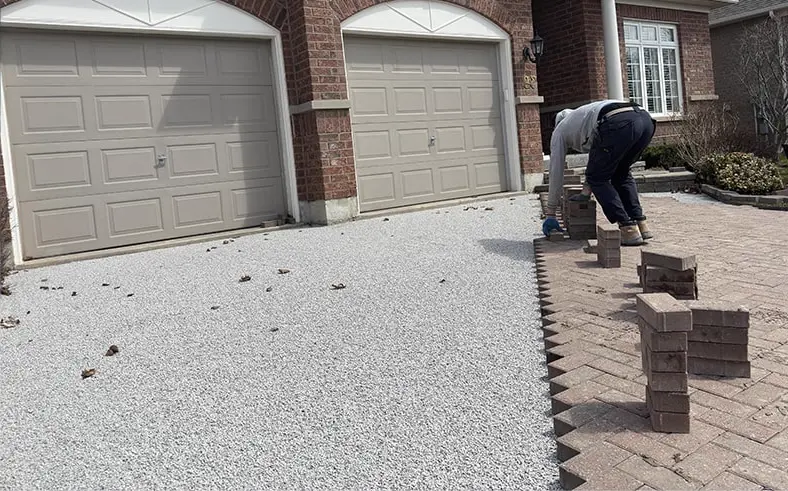
Uneven Pavers at the Front Door: Fast Fix Options Before Winter
Walking up to your Ottawa home should not feel like navigating an obstacle course. Learn about fast fix options for uneven pavers at your front door before winter hits, including costs, timelines, and why you need to act now.
Walking up to your Ottawa home should not feel like navigating an obstacle course. If you have noticed uneven pavers at your front door, you are not alone and you are running out of time to fix them before winter hits.
Uneven pavers at your front entrance are not just an eyesore. They are a safety hazard that gets exponentially worse when temperatures drop. That innocent 1-inch lip becomes a concealed ice trap when snow accumulates. The small depression that pools water in September turns into a skating rink in December.
Let us talk about why your front door pavers settled unevenly, what fast-fix options exist, and why you need to act now before the first hard freeze locks everything in place until spring.
Why Front Door Pavers Settle Unevenly
Your front entrance experiences unique stresses that other parts of your interlock installation do not face. Understanding the root cause helps you choose the right repair strategy.
Frost Heave Takes No Prisoners
In Ottawa freeze-thaw climate, frost heave is public enemy number one. Water infiltrates the base material beneath your pavers. When temperatures drop below freezing, that water expands by approximately 9 percent. The ground literally lifts unevenly.
Front door areas are particularly vulnerable because:
- They are often located where roof runoff concentrates
- Downspouts frequently terminate too close to the entrance
- Snow gets piled against the house during shoveling
- De-icing salt draws more moisture into the base
The result? Some pavers rise while others stay put. By spring, when everything thaws, the pavers do not return to their original position. You are left with an uneven, hazardous surface.
Poor Base Preparation Haunts You Later
If your interlock was installed with inadequate base preparation, problems emerge at high-traffic, high-stress points first like your front entrance.
Red flags indicating poor base work:
- Less than 6 inches of compacted granular base
- No geotextile fabric separating base from soil
- Insufficient compaction (should be done in 2-inch lifts)
- Wrong aggregate type (round river rock instead of angular crushed stone)
These shortcuts save installers time and money upfront but guarantee premature failure. Front entrances show these deficiencies first because they experience the most foot traffic and the greatest temperature fluctuations.
Water Pooling Creates a Downward Spiral
Notice water pooling on your front step area after rain? That is not just annoying it is actively destroying your installation.
Water pooling indicates:
- Improper slope (should be 2 percent away from house)
- Settlement has created a depression
- Damaged or insufficient edge restraint allowing pavers to spread
- Compromised base allowing fine particles to wash away
Once pooling starts, it accelerates. Water saturates the base, weakening it further. During freeze-thaw cycles, ice expansion makes the depression worse. By the time you notice, the problem has been compounding for months or years.
Foundation Settlement and Soil Movement
Your home foundation and the surrounding soil are not static. Clay-rich Ottawa soil expands when wet and contracts when dry. New construction settles for years after being built.
Front entrance pavers installed within 3-5 feet of the foundation often experience differential settlement:
- The section nearest the foundation settles with the building
- The section farther out settles with the soil
- The result is a hinge point where pavers become uneven
This is especially common in homes less than 5 years old or in areas with poor soil conditions.
Winter Urgency: Why This Cannot Wait Until Spring
I will just deal with it next spring is the most dangerous decision Ottawa homeowners make regarding uneven front entrance pavers.
The Ice Trap Multiplier Effect
Uneven pavers create lips and depressions. Small height differences become invisible death traps under snow and ice:
- A 1-inch lip hidden under 2 inches of snow becomes a trip hazard
- Depression areas fill with water, freeze solid, and create black ice
- Snow accumulation obscures the problem while making it more dangerous
- De-icing salt concentrates in low spots, accelerating base deterioration
You are not just risking a twisted ankle. You are risking a lawsuit if someone gets seriously injured on your property. Homeowner insurance does not look kindly on known hazards that were not addressed.
Freeze-Lock Until April
Once the ground freezes solid (typically mid-December in Ottawa), repair becomes impossible until spring thaw (late March to early April).
That means:
- 4-5 months of living with a hazardous entrance
- 4-5 months of liability exposure
- 4-5 months of water damage progression underground
- Repair costs that increase by 30-50 percent as the problem worsens
Water Expansion Accelerates Damage
Every freeze-thaw cycle makes uneven pavers worse. Water infiltrates cracks and joints, freezes, expands, and pushes pavers further apart or upward.
A modest unevenness in October becomes a severe hazard by February. Pavers that could be shimmed in September need full releveling by March. Problems that could be fixed for 400 dollars in autumn cost 1,500 dollars in spring.
Fast Fix Options: From Temporary to Permanent
You have three repair strategies, each with different costs, timelines, and longevity. Your choice depends on your budget, timeline, and root cause analysis.
Option 1: Shimming Pavers (Temporary Fix)
What it is: Lifting individual pavers and placing shim material (rubber, plastic, or composite shims) underneath to level them.
Best for:
- Emergency fixes when winter is imminent
- Minor unevenness (less than half inch)
- Situations where root cause will be addressed next season
Cost: 100-300 dollars for 2-4 pavers
Timeline: 1-2 hours
Longevity: 1-2 years maximum
Pros:
- Extremely fast
- Minimal disruption
- Very affordable
- Can be done in cold weather (above freezing)
Cons:
- Does not address root cause
- Shims can shift during freeze-thaw
- Not suitable for significant unevenness
- Purely cosmetic/safety fix
DIY potential: High for handy homeowners with proper shims
Option 2: Lifting and Resetting (Semi-Permanent Fix)
What it is: Removing affected pavers, adding/removing base material as needed, re-compacting, and resetting pavers properly.
Best for:
- Moderate unevenness (half to 1.5 inches)
- Localized problems (not widespread settlement)
- When base material is generally sound
Cost: 300-800 dollars for 2-4 pavers and surrounding area
Timeline: 4-6 hours (half day)
Longevity: 5-10 years if done properly
Pros:
- Addresses immediate base issues
- Properly reset pavers are as good as new
- Moderate cost
- Can fix slope/drainage issues in that area
Cons:
- Requires matching existing pavers (or accepting slight color variation)
- Weather-dependent (needs above-freezing temps)
- Will not help if wider area has base problems
- Requires professional compaction equipment
DIY potential: Low requires plate compactor and technique
Option 3: Full Entry Releveling (Permanent Solution)
What it is: Complete removal of entrance pavers, excavation to assess/repair base, installation of proper base layers with geotextile, and complete reinstallation.
Best for:
- Severe unevenness (over 1.5 inches)
- Widespread settlement across entire entrance
- When drainage problems exist
- When you want a 20+ year solution
Cost: 1,500-3,500 dollars depending on area size
Timeline: 2-3 days
Longevity: 20+ years with proper maintenance
Pros:
- Permanent solution
- Opportunity to fix drainage and slope
- Can upgrade to better pavers if desired
- Addresses all root causes
- Increases home value and curb appeal
Cons:
- Highest cost
- Longest timeline
- Weather-dependent
- May reveal additional foundation drainage issues
DIY potential: Very low professional job
Root Cause Assessment: Critical Before You Choose
Throwing money at the wrong solution wastes your budget and leaves you with the same problem next year.
Does Frost Heave Need a Drainage Fix?
If frost heave caused your uneven pavers, shimming or simple resetting will not last. You need to eliminate the water source:
Drainage solutions:
- Extend downspouts 6+ feet from entrance
- Install French drain along foundation
- Regrade soil to slope away from house
- Add or improve gutters over entrance area
- Ensure proper slope in paver installation (2 percent minimum)
A professional assessment costs 100-200 dollars but can save you thousands in repeated failed repairs.
Does Poor Base Need Complete Relay?
If inadequate base caused the problem, partial fixes are band-aids. Signs you need complete releveling:
- Unevenness across entire entrance (not just 1-2 pavers)
- Pavers rock when stepped on
- Joints wider than 3mm
- Visible base material in joints
- Multiple previous fixes that failed
Do not throw good money after bad. A proper relay costs more upfront but eliminates the problem permanently.
Is Foundation Settlement the Culprit?
If your home foundation is settling, you may have a bigger issue than pavers. Warning signs:
- Cracks in foundation walls
- Doors/windows sticking
- Interior drywall cracks
- Uneven floors inside
- Gaps between siding and foundation
Consult a structural engineer before spending money on paver repairs. Foundation issues can cost 5,000-15,000+ dollars, but ignoring them causes exponentially more expensive problems.
Before-Winter Repair Timeline: When to Act
Ottawa weather creates a narrow window for outdoor masonry work.
Ideal Repair Window: September to Early November
Why this window works:
- Temperatures consistently above 10 degrees Celsius
- Ground not frozen
- Low precipitation likelihood
- Contractors still available
- Materials readily available
- Adequate curing time before hard freeze
Book now: Most reputable Ottawa interlock contractors are scheduling 2-3 weeks out during peak season. If it is already late October, you are looking at a November completion which is cutting it close.
Risky Window: Mid-November to Early December
Challenges:
- Temperature swings (may freeze overnight)
- Ground may freeze during project
- Rain/snow more likely
- Polymeric sand needs 24-48 hours above 10 degrees Celsius to cure
- Compaction less effective in cold soil
Only attempt: Simple shimming or emergency temporary fixes. Not ideal for complete releveling.
Impossible Window: Late December to March
Why it will not work:
- Frozen ground cannot be excavated
- Base material will not compact properly
- Polymeric sand will not cure
- Mortar and adhesives will not set
- Risk of frost damage during installation
Your only option: Temporary safety measures until spring.
Temporary Safety Measures If Repairs Must Wait
If you have missed the repair window, protect yourself and others until spring:
Physical Barriers and Warnings
- Caution tape: Bright yellow/orange tape around uneven area
- Warning sign: Uneven surface watch your step
- Improved lighting: Motion-sensor LED lights to illuminate the area
- Contrasting paint: Bright paint on the raised edge (remove in spring)
These measures reduce liability by showing you acknowledged and warned about the hazard.
Temporary Ramps and Shims
- Rubber threshold ramp: Beveled rubber ramp to bridge height difference
- Anti-slip tape: Heavy-grit tape on raised edges
- Sand buckets: Readily available sand/salt for ice management
- Rubber mats: Heavy-duty entrance mats to create level surface
These are not permanent solutions but can make the area safer until proper repairs.
Aggressive Ice Management
- Daily de-icing: Apply calcium chloride (works to -25 degrees Celsius) not just salt
- Immediate snow removal: Do not let snow accumulate and hide unevenness
- Water diversion: Temporary foam barriers to redirect water away from problem areas
- Absorbent materials: Cat litter or sand in depressions to soak up pooling water
Document everything with photos. If someone gets injured despite your efforts, evidence of mitigation helps with liability.
Drainage Solutions: Stop the Problem at the Source
Most uneven paver problems trace back to water management failures.
Regrading the Slope
Your front entrance should slope AWAY from your home at 2 percent minimum (quarter inch per foot):
- Measure current slope with 4-foot level and ruler
- If slope is inadequate, releveling project must include slope correction
- Check for back slope toward house (common installation error)
Proper slope ensures water runs away from pavers and foundation, eliminating the primary cause of frost heave and settlement.
Gutter and Downspout Management
Downspouts dumping water near your entrance are slow-motion destruction:
Solutions:
- Extend downspouts 6 feet minimum from house
- Install underground drainage to route water to street/storm sewer
- Add rain barrels to capture and slowly release water
- Install splash blocks to disperse water over wider area
- Clean gutters twice yearly to prevent overflow
A 200 dollar downspout extension can eliminate a 2,000 dollar paver problem.
French Drain Installation
For persistent water problems, a French drain along the foundation perimeter is the ultimate solution:
Benefits:
- Intercepts groundwater before it reaches pavers
- Protects foundation from moisture damage
- Eliminates frost heave risk
- Reduces basement moisture and mold
Cost: 3,000-8,000 dollars for perimeter drain
Longevity: 25+ years
Expensive, but if you are doing full entrance releveling anyway, adding a French drain during excavation makes sense.
Professional Timeline and What to Expect
Understanding the professional repair process helps you plan and budget.
1-Day Emergency Shim or Reset
Day 1:
- Morning: Assessment and material pickup
- Midday: Remove affected pavers, assess base
- Afternoon: Add/remove material, compact, reset pavers
- Evening: Sweep polymeric sand (if weather permits)
Total time: 4-6 hours
Cost: 300-800 dollars
2-3 Day Proper Releveling
Day 1:
- Remove all entrance pavers (save for reinstallation)
- Excavate to assess base condition
- Remove inadequate base material
- Install geotextile fabric
- Begin base layer installation
Day 2:
- Complete granular base installation
- Compact in 2-inch lifts
- Install bedding sand layer
- Screed to proper grade and slope
Day 3:
- Reset pavers in running bond or pattern
- Cut edge pavers as needed
- Compact pavers with plate compactor
- Apply polymeric sand
- Final compaction and cleanup
Total time: 2-3 days (weather dependent)
Cost: 1,500-3,500 dollars
Cost Breakdown: Budget for Quality
Ottawa interlock repair costs vary based on scope and timing:
Temporary Fixes (200-400 dollars)
- Shimming 2-4 pavers: 100-300 dollars
- Emergency same-day service: +100-200 dollars
- Temporary safety measures: 50-150 dollars
Total: 200-400 dollars for temporary peace of mind until spring
Partial Repairs (500-1,200 dollars)
- Lift and reset 10-15 sq ft entrance area: 500-800 dollars
- Base material and compaction: +100-200 dollars
- Polymeric sand and cleanup: +75-150 dollars
- Same-week service: +100 dollars premium
Total: 500-1,200 dollars for semi-permanent fix
Full Releveling (1,500-3,500 dollars)
- Complete excavation and base repair: 800-1,500 dollars
- Labor (2-3 day project): 600-1,200 dollars
- Materials (base, sand, polymeric sand): 200-400 dollars
- Slope/drainage corrections: +200-500 dollars
- Matching pavers (if needed): +150-300 dollars
Total: 1,500-3,500 dollars for permanent solution
Add-On Services
- French drain installation: +1,500-3,000 dollars
- Downspout extension: +200-500 dollars per downspout
- New paver upgrade: +300-800 dollars depending on style
- Sealing after repair: +200-400 dollars
Do Not Wait Protect Your Investment and Your Safety
Uneven pavers at your front door are not getting better on their own. Every day you wait:
- The problem gets worse
- Repair costs increase
- Safety risks multiply
- Your repair window narrows
If you are reading this in September or October, you have time for a proper fix. If it is November, you need to act NOW for even temporary solutions. If it is December or later, implement safety measures and plan for spring.
The good news? Professional interlock repair delivers lasting results when done properly. You will have a safe, beautiful, level entrance that enhances your home curb appeal and protects your family and visitors.
Get Your Front Entrance Fixed Before Winter
Interlock Experts has been repairing uneven pavers and releveling front entrances across Ottawa for over 15 years. We understand the unique challenges of Ottawa freeze-thaw climate and how to deliver repairs that last decades, not just seasons.
Whether you need an emergency temporary fix before the first snowfall or a complete professional releveling next spring, we can help. Our team will:
- Assess the root cause of your uneven pavers
- Provide honest recommendations (we will not oversell)
- Deliver fast, quality repairs with workmanship warranty
- Fix drainage issues to prevent recurrence
- Match existing pavers or upgrade to premium options
Do not risk injury or expensive spring repairs. Call Interlock Experts today at +1 613 981 0199 for a free assessment and quote. We are booking fall emergency repairs and spring projects now.
Winter is coming let us make sure your front entrance is ready.
Related Services:
- Interlock Repair – Complete repair solutions for damaged or settled pavers
- Interlock Step Repair – Specialized repairs for steps and entrances
- Contact Us – Schedule your free assessment today
Serving Ottawa and surrounding areas including Kanata, Barrhaven, Orleans, Nepean, Stittsville, Gloucester, Manotick, and more.